
Why Upper Trapezius Stiffness Needs Targeted Thermal and Mechanical Relief
Anyone who spends hours hunched over a workstation or managing warehouse inventory knows that dull, burning ache right where the neck meets the shoulder blades. From a biomechanical standpoint, holding the head slightly forward increases the effective load on the cervical spine from roughly ten pounds to nearly forty pounds. Over time, the upper trapezius and levator scapulae muscles lock into a state of sustained isometric contraction, squeezing local capillaries shut and starving the tissue of oxygen.
A Wearable Cozy Heat Neck & shoulder massager addresses this exact physiological bottleneck by pairing continuous thermal output with rhythmic mechanical kneading. Instead of just masking discomfort on the surface, mild heat triggers local vasodilation, widening blood vessels so fresh oxygen can flush out accumulated lactic acid and metabolic waste. When the muscle fibers warm up by just two or three degrees Celsius, tissue viscoelasticity improves significantly, allowing the massage nodes to press deeper without triggering the body's defensive stretch reflex.
Inside the Hardware of Modern Hands-Free Shiatsu Massagers
Early electric massagers were essentially heavy wooden rollers stuffed into a faux-leather pillow that required constant downward pulling on arm loops. If the user stopped pulling, the nodes simply grazed the skin without reaching the deeper fascia. Modern wearable designs solve this ergonomic flaw through contoured structural geometry and adjustable buckle straps that anchor the unit around the upper back, freeing up both hands for typing, reading, or relaxing.
Under the fabric hood, the mechanical layout makes all the difference between a soothing rub and an annoying pinch. High-grade units rely on brushless direct current motors paired with angled 3D or 4D silicone kneading heads that mimic the inward and upward rolling motion of a physical therapist's thumbs. Rather than using outdated nichrome heating wires that create uncomfortable hot spots, well-engineered wearable massagers integrate carbon fiber infrared heating films or positive temperature coefficient thermistors controlled by negative temperature coefficient sensors. This closed-loop setup keeps surface temperatures steady between 40°C and 45°C, aligning with the IEC 60601-2-35 safety guidelines for thermal therapeutic pads to prevent low-temperature skin burns during a standard fifteen-minute cycle.
| Engineering Parameter | Legacy Handheld Loop Pillow | Modern Hands-Free Wearable Massager |
|---|---|---|
| Structural Anchoring | Manual downward arm tension required | Elastic back-buckle strap for hands-free wear |
| Kneading Mechanism | Rigid POM plastic balls on fixed tracks | Angled silicone nodes with variable-pitch gearing |
| Thermal Control System | Basic heating wire with wide thermal drift | Carbon fiber film with real-time NTC sensor regulation |
| Acoustic Noise Profile | 55 to 62 dB with noticeable gear whine | 42 to 48 dB suitable for quiet shared spaces |
| Typical Unit Weight | 1.8 kg to 2.3 kg | 1.1 kg to 1.35 kg for minimal cervical load |
Field Observations From a Regional Wellness Product Trial
Theory on a spec sheet only goes so far, and real-world testing always reveals what matters most to end users. During a fourth-quarter product evaluation with a mid-sized North American personal care distributor, a sourcing team tested forty sample units of a cordless heated neck wrap across a group of long-haul logistics dispatchers and remote software engineers. During the first two weeks, feedback showed that units using rigid polyoxymethylene massage heads caused soreness over the seventh cervical vertebra whenever users leaned back against an office chair.
To fix this issue, the product engineers swapped the rigid plastic heads for dual-durometer silicone nodes rated at 35 Shore A on the outer surface and adjusted the cam angle by twelve degrees to straddle the spinous process rather than pressing directly on the bone. At the same time, the thermal ramp-up curve was recalibrated so the cozy heat reached 42°C within ninety seconds instead of taking five minutes. Once those tweaked units went back out for the second phase of testing, daily completion rates for full fifteen-minute sessions jumped noticeably, and complaints about bony pressure points dropped to zero.
Practical Buying Criteria for Procurement Teams and Everyday Users
Whether sourcing inventory for a retail wellness line or picking out a reliable unit for daily home recovery, evaluating a heated shoulder kneader comes down to a few verifiable details under the surface:
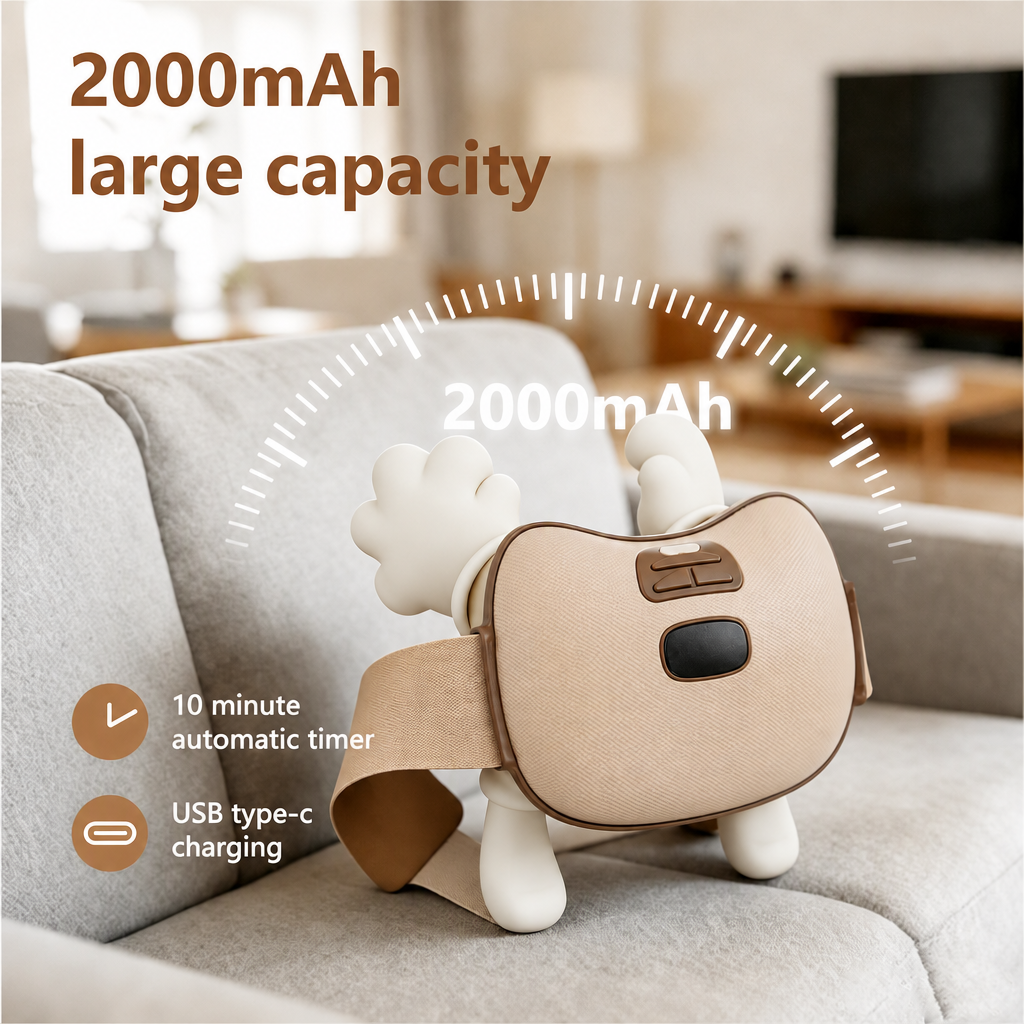
1.Check the battery chemistry and discharge protection. A dependable cordless wearable massager typically runs on a 2000mAh to 2500mAh lithium-ion cell certified under UL 1642 or IEC 62133, delivering six to eight full fifteen-minute sessions per charge without voltage sag slowing down the motor torque.
2.Inspect the fabric abrasion and skin-contact ratings. Because heat and sweat accelerate material breakdown, the inner liner touching the neck should use breathable, skin-friendly Lycra or brushed microfiber that meets RoHS and REACH chemical safety standards, ideally paired with a removable, washable dust cover.
3.Test the stall-torque protection circuit. If someone leans heavily against a sofa while wearing the device, the motor controller should detect the spike in current draw and automatically adjust torque or shut down safely rather than stripping the internal nylon gearbox.
Honest Operational Boundaries and Safe Usage Habits
Even the best-built thermal kneading wrap has clear operational boundaries that users need to respect. A wearable cozy heat massager is designed for myofascial relaxation and temporary relief of everyday muscular tension, not for treating acute cervical disc herniation, nerve root compression, or fresh whiplash injuries. Applying deep mechanical pressure or heat over acutely inflamed tissue can actually worsen local swelling during the first forty-eight hours of an injury.
Safety around the anterior neck is equally critical. The massage nodes must always stay positioned along the posterior cervical muscles and upper trapezius, never rotated toward the front of the throat where the carotid sinus and major blood vessels sit. Limiting each session to fifteen or twenty minutes gives the deep tissue enough stimulation to loosen up without causing rebound muscle soreness the next morning.
How Manufacturing Standards Shape Long-Term Device Reliability
Getting the balance of gentle warmth, quiet motor torque, and ergonomic fit right requires serious factory-floor discipline rather than simple off-the-shelf assembly. Established manufacturers like Emoka bring decades of specialized engineering to this category, operating under strict ISO 9001 and ISO 13485 quality management frameworks alongside FDA, CE, FCC, and RoHS compliance. By controlling the entire production chain from raw material traceability and mold tooling to full-unit aging tests, Emoka helps global wellness brands and distributors deliver durable, comfortable massage hardware that holds up under daily real-world use.
Table of Contents
- Why Upper Trapezius Stiffness Needs Targeted Thermal and Mechanical Relief
- Inside the Hardware of Modern Hands-Free Shiatsu Massagers
- Field Observations From a Regional Wellness Product Trial
- Practical Buying Criteria for Procurement Teams and Everyday Users
- Honest Operational Boundaries and Safe Usage Habits
- How Manufacturing Standards Shape Long-Term Device Reliability