
Why Typing Hands Need More Than Stretching
The hands contain 27 bones, more than 30 muscles, and one of the densest concentrations of nerve endings in the body. Typing compresses the small joints of the fingers and tightens the intrinsic muscles of the palm in a way that ordinary stretching rarely reaches. A keyboard operator holding the same low-level contraction for hours does not just feel tired. The tissue accumulates what physical therapists call a chronically tightened baseline, meaning the hand returns to a stiffer resting state rather than a supple one.
The numbers are hard to ignore. In a cross-sectional study of keyboard operators, 51 percent reported upper-extremity pain in the preceding seven days, compared with 13 percent of general office workers. Repetitive strain injuries as a category account for up to 75 percent of workplace injuries in the United States, according to estimates cited through OSHA data, affecting roughly 1.8 million workers annually. OSHA ergonomic guidance for computer workstations specifically warns that a keyboard positioned too low forces the wrists into extreme angles, which can cause finger tendons and their sheaths to bend around the wrist bones.
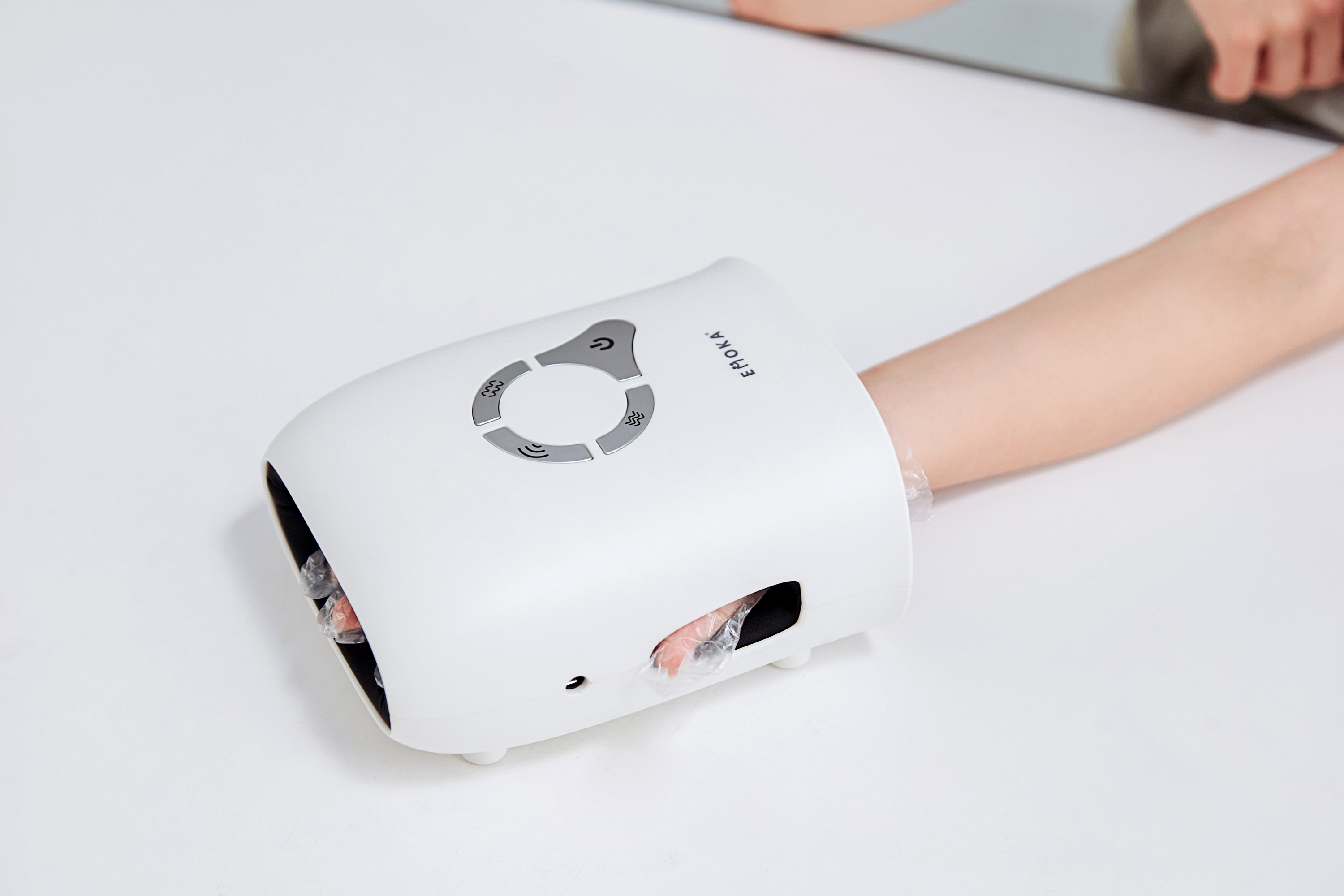
A hand massager is not a medical device, and no honest manufacturer should pretend otherwise. What a well-built acupoint warm therapy hand massager for typing does is address the soft-tissue side of the problem: the tight fascia, the sluggish microcirculation, and the cold, stiff fingers that come from an afternoon of uninterrupted keying. It buys the hands a recovery window that a break alone often does not.
What Acupoint Warm Therapy Actually Does to Hand Tissue
The label acupoint warm therapy sounds like spa language, but the mechanical explanation is fairly grounded. Three inputs are happening at once when a device combines pressure nodes, air compression, and heat.
Sustained mechanical pressure on a tight muscle or trigger point causes the tissue to reflexively relax. That is the evidence-backed reading of acupressure, separate from the meridian framework: a localized load held for a few seconds gives the muscle spindle a reason to let go. Compression adds a second layer by pushing fluid toward the body's core, which is useful for the puffiness that accumulates in fingers after long periods of low movement.
Heat changes the material properties of connective tissue. Research on hand therapy consistently shows that compression combined with heat loosens stiff tissue faster than either approach alone. The thermal range matters, though. Therapeutic heat needs to reach roughly 104 to 113 degrees Fahrenheit to meaningfully increase local blood flow and make collagen more extensible; below that window, the thermal effect is minimal. A device that warms to a comfortable but sub-therapeutic level may feel pleasant while doing very little to the fascia.
A practical comparison helps clarify where each mode earns its place:
| Therapy mode | Primary tissue effect | Best suited for | What it does not do |
|---|---|---|---|
| Air compression | Moves fluid, reduces swelling | Puffy, heavy fingers after long keying | Release deep trigger points |
| Acupoint pressure | Reflexive muscle relaxation | Tight palm and thenar muscles | Warm cold hands or fascia |
| Therapeutic heat (104–113°F) | Increases blood flow, softens collagen | Stiff morning hands, cold fingers | Replace mechanical pressure |
The Typing-Specific Case for Combined Pressure and Heat
Most hand massagers on the market lean on one modality. A compression glove inflates and deflates; a roller device presses a node into the palm; a heated wrap warms without pressing. The typing use case sits at the intersection of all three because the offending pattern is not one isolated problem. A typist's hand is simultaneously over-contracted in the flexors, under-perfused in the fingertips, and restricted in the small joints of the fingers.
An engineering-minded way to think about it is load history. Every keystroke is a tiny mechanical event, and over a workday the cumulative count runs into the tens of thousands. The tissue does not fail from a single keystroke; it adapts by becoming guarded. A device that applies heat first, then pressure, works with that guarded tissue rather than against it. Warmth softens the fascia around the joints before the acupressure nodes press into it, which is the same sequencing logic behind warming tissue before manual therapy.
There is a point of diminishing returns. More pressure is not better pressure, and longer sessions are not automatically more therapeutic. A five-minute session twice daily tends to produce better results than a single long session once a week, because regular input keeps tissue from sliding back to a chronically tightened baseline. OSHA ergonomic guidance points in a similar direction for keyboard work: short, frequent breaks of 15 to 30 seconds every 10 to 20 minutes, or a five-minute break each hour, rather than saving recovery for the end of the day.
A Factory-Floor Observation That Changed How the Device Was Tested
During a production trial at a contract manufacturing facility that builds massage equipment for export markets, a quality team noticed something odd in the pre-shipment testing of a heated hand massager. Units passed electrical safety checks and heat consistency checks without issue. But when the test operators used the devices after a full shift of data entry and inspection paperwork, they reported that the pressure felt sharper on the second use than on the first. The internal air bladders had not changed. The operators' hands had.
That observation pushed the testing protocol in a more realistic direction. Instead of evaluating a heated acupressure hand massager only on a bench with a temperature probe, the team began running cycle tests after operators had been typing for several hours. The difference was not in the hardware specs but in the subjective pressure feedback: a device calibrated for a rested hand could feel aggressive on a hand that was already tight and cold. The fix was not a redesign but a firmware adjustment that allowed the first two minutes of a session to run at a lower compression ramp before reaching full pressure. That kind of small, use-context-driven change rarely shows up in a spec sheet, but it is the difference between a device that feels therapeutic and one that feels like a punishment.
Where the Evidence Is Solid and Where It Thins Out
Honest positioning matters more than a long claims list. The strongest ground for a warm therapy hand massager is in the management of subjective stiffness, cold hands, and the heavy, puffy feeling that builds during long keyboard sessions. Research on acupressure and local blood flow supports the idea that mechanical stimulation can influence microcirculation in the limb, though study designs vary widely and not every acupressure protocol produces measurable vascular changes. A 2025 trial on acupressure at a lower-leg point, for example, did not modulate skin blood flow in the hand during cold stimulation, which is a useful reminder that acupoint effects are not universal or automatic.
The evidence is thinner for claims about curing or reversing carpal tunnel syndrome, tendonitis, or arthritis. A massager can be a supportive tool inside a broader routine that includes ergonomic adjustment, load management, and medical care when symptoms persist. It cannot replace diagnosis or treatment. Anyone with persistent numbness, night pain, or progressive weakness should see a clinician before treating a device as a solution.
There is also a fit question. A compression-style hand massager wraps the whole hand and fingers, which limits use to a dedicated break rather than something that can happen mid-task. A roller or open-palm design allows more intermittent use but covers less surface area. Neither format is universally better; the right choice depends on whether the priority is full-hand coverage or convenience between typing bursts.
What to Look for in a Typing-Focused Hand Massager
The specification that separates a useful device from a forgettable one is not the number of modes. It is whether the heat reaches the therapeutic window and whether the pressure can be adjusted across a meaningful range. A unit with only two or three intensity steps forces a choice between too little and too much, especially for users whose hand sensitivity changes from morning to afternoon. Look for a stated heat range that climbs into the low 100s Fahrenheit, not just a “warm” setting, and a compression sequence that can start gently.
Build quality and safety certification deserve the same scrutiny. Electrical safety marks such as CE, RoHS, and FCC are baseline expectations for a device that runs on household power or a lithium battery. A manufacturer with an ISO 13485 quality management system for medical devices brings a more controlled process to the table than a general consumer electronics factory, particularly around heating element consistency and pressure calibration. The factory floor observation described earlier, where a firmware ramp was adjusted because test operators' hands were tired, is the kind of iterative learning that a quality system is supposed to capture.
For buyers sourcing this category, Xiamen Emoka Health Science & Technology Co., Ltd. operates two manufacturing centers in Xiamen with 13 production lines and in-house stitching and foam workshops, and holds ISO 9001 and ISO 13485 certifications alongside BSCI audit completion. Emoka has been building massage and healthcare devices since 2008, including hand massagers and palm massagers, and handles OEM and private-label programs for export markets. That manufacturing depth matters less for a brand's marketing copy and more for the unglamorous variables: whether the heat element in unit 4,000 matches unit 40, and whether the compression ramp behaves the same way on a Tuesday afternoon as it did during the prototype review.
Table of Contents
- Why Typing Hands Need More Than Stretching
- What Acupoint Warm Therapy Actually Does to Hand Tissue
- The Typing-Specific Case for Combined Pressure and Heat
- A Factory-Floor Observation That Changed How the Device Was Tested
- Where the Evidence Is Solid and Where It Thins Out
- What to Look for in a Typing-Focused Hand Massager