
It Starts With a Pump, a Valve, and a Very Small Computer
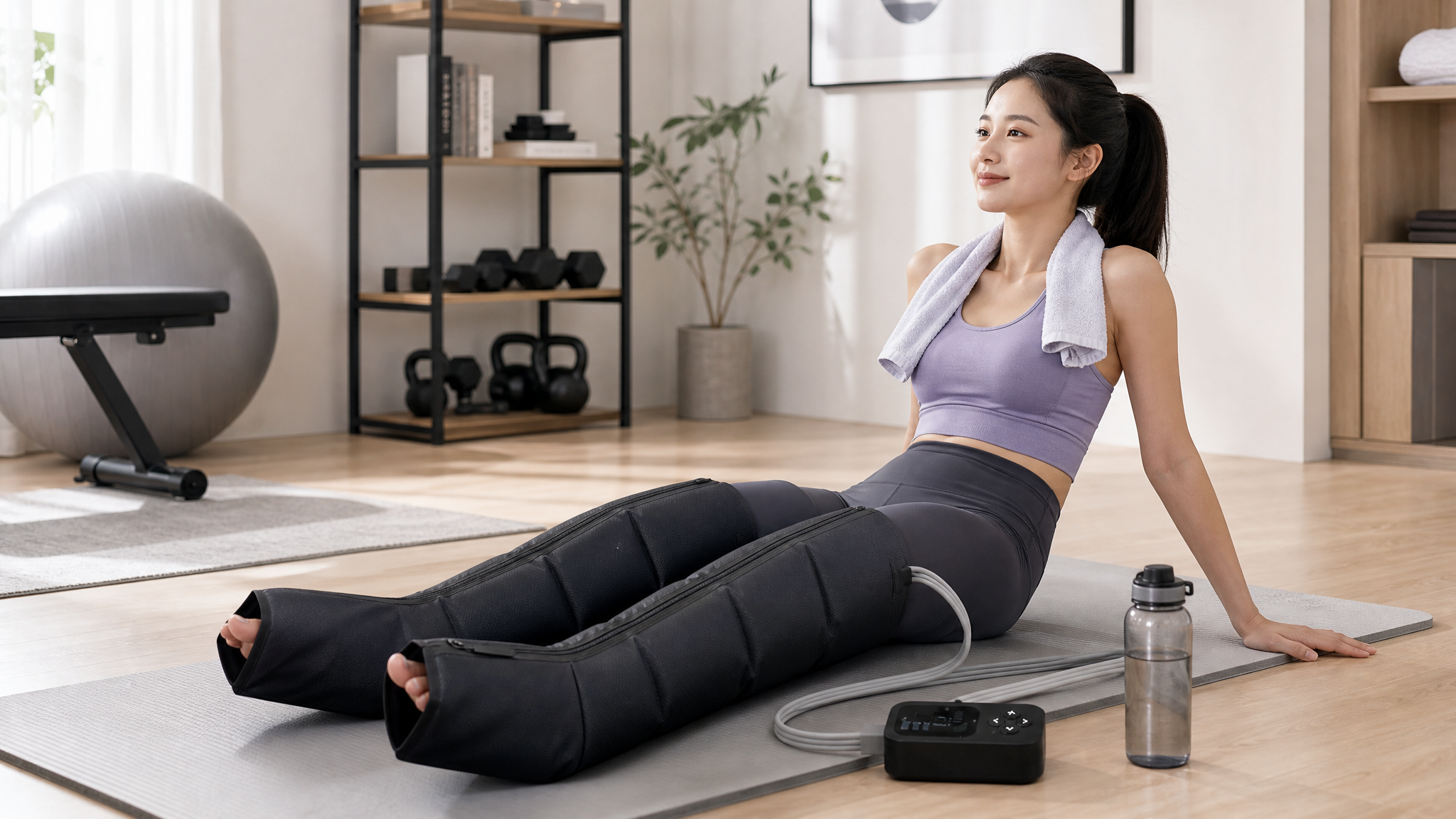
Strip away the fabric and the branding, and an air compression leg massager is a closed-loop pneumatic system. A small DC-powered pump pushes air through tubing into one or more bladders wrapped around the limb. Solenoid valves decide where that air goes and when it comes back out. A pressure sensor watches the whole exchange in real time, and a microprocessor runs the timing sequence that turns a simple inflate-and-deflate action into something the body reads as a rhythmic squeeze.
The engineering challenge is not making a bag get bigger. It is making that bag get bigger at the right place, at the right moment, and at the right pressure, then letting go fast enough that blood has a reason to move. The pump can be modest. The logic behind it cannot.
Pressure Is Only Half the Story. Timing Does the Rest
A common assumption is that more pressure equals more benefit. Hemodynamic data says otherwise. In a controlled study on healthy volunteers, simultaneous compression at 50 mmHg produced a significant rise in peak venous velocity, but the response was far more variable than what appeared at 30 mmHg. Five participants even showed a dipping pattern consistent with possible venous occlusion at the higher setting. The lower pressure, applied across all chambers at once, delivered the most consistent peak velocity boost, roughly 90 percent above baseline.
That finding matters for anyone shopping by numbers alone. A device that advertises 200 mmHg or more is not automatically doing more for circulation. What it is doing is creating a sharper external force that the body may resist or tolerate unevenly. The useful work happens in the relationship between inflation speed, hold time, and release.
Why Sequential Inflation Feels Different From a Simultaneous Squeeze
Most consumer leg massagers inflate every chamber at once. Better systems inflate in a sequence, usually starting at the ankle and moving upward toward the calf and thigh. The difference is not cosmetic. Sequential inflation mimics the way the calf muscle pump actually works during a step: the lower leg empties first, then the pressure wave travels proximally, pushing venous blood toward the heart instead of trapping it below the knee.
The trade-off is visible in the numbers. Sequential 30 mmHg did not produce the highest peak velocity in the same volunteer study, but it produced the longest augmented flow duration, nearly 4.5 seconds compared with less than 2 seconds for simultaneous compression at the same pressure. For circulation, duration can matter as much as the initial spike. A longer wave means more total venous volume displaced, even if the top speed is lower.
| Compression Mode | Mean Peak Systolic Velocity | Augmented Flow Duration | Practical Read |
|---|---|---|---|
| Simultaneous, 30 mmHg | ~40 cm/s, about 90% above baseline | ~1.85 s | Strong, consistent peak; shorter window |
| Simultaneous, 50 mmHg | ~30 cm/s, more variable | ~2.34 s | Higher pressure did not outperform 30 mmHg |
| Sequential, 30 mmHg | Lower peak than simultaneous 30 mmHg | ~4.49 s | Longer propulsion window, closer to natural calf pump |
Data adapted from a peer-reviewed intermittent pneumatic compression pilot study on healthy volunteers.
The Parts That Keep the System Honest Under Load
A leg massager that works on a test bench and a leg massager that works on a real calf are two different products. Real limbs vary in circumference, tissue firmness, and how much pressure they can comfortably accept. That is why pressure feedback is not optional on a well-built unit. The sensor reads the actual bladder pressure, the controller compares it to the target, and the pump shuts off or the valve vents before the limb is asked to absorb more than it should.
Safety standards pick up where the controller leaves off. Devices marketed in the U.S. commonly demonstrate compliance with IEC 60601-1 for general electrical safety and IEC 60601-1-11 for the home healthcare environment. Those standards do not guarantee a pleasant massage, but they do set a baseline for insulation, leakage current, and fault behavior when the device is used on a living room couch rather than in a clinic.
A Production Floor Lesson in Air Leakage and Sleeve Tolerance
A few years ago, during a run of compression sleeves for a home-use leg massager, a QC check found that a batch was reaching its target pressure more slowly than the engineering sample. The pump and valves were fine. The problem was the seam allowance on the internal bladder. A few millimeters of variation changed how the fabric expanded against the outer sleeve, and the controller was compensating by running the pump longer than expected.
The fix was not a new algorithm. It was tighter control of the cutting and stitching process, plus a pressure-decay test on finished sleeves before they left the line. That kind of issue is common in pneumatic wearables. The software can be perfect and the hardware can still behave differently when a textile component drifts. Manufacturers with in-house stitching and foam workshops tend to catch these problems earlier because the bladder, the sleeve, and the tubing are not coming from three unrelated suppliers.
What the Mechanism Can and Cannot Do
Air compression works because it temporarily narrows the venous space in the limb, which increases local blood velocity and reduces pooling. That is a mechanical effect, not a chemical one, and it is why the sensation is often described as a firm squeeze followed by a release. It can feel good after standing all day or sitting through a long flight. It can help a healthy person feel looser through the calves.
The limits deserve equal time. Compression does not replace movement. It does not fix a vascular condition, and it is not a substitute for medical evaluation of persistent swelling or pain. Higher pressure is not a shortcut to a better session. For anyone with compromised circulation, fragile skin, or a diagnosed clotting disorder, the pressure settings and duration should be discussed with a clinician rather than chosen from a dial.
Emoka has been building massagers since 2008, with ISO 9001 and ISO 13485 systems, in-house testing, and production lines that handle the pump-and-bladder assembly as one controlled process rather than a collection of outsourced parts. That background matters when the goal is a pneumatic system that behaves the same way on cycle one and cycle one thousand.
Table of Contents
- It Starts With a Pump, a Valve, and a Very Small Computer
- Pressure Is Only Half the Story. Timing Does the Rest
- Why Sequential Inflation Feels Different From a Simultaneous Squeeze
- The Parts That Keep the System Honest Under Load
- A Production Floor Lesson in Air Leakage and Sleeve Tolerance
- What the Mechanism Can and Cannot Do